Rooftop Vegetable Garden Plans: A Deep Technical & Structural
The conversion of sterile, bitumen-coated rooftops into productive agricultural zones represents one of the most significant shifts in contemporary urban metabolism. Unlike ground-level gardening, where the earth provides a natural buffer for moisture, temperature, and structural support, a rooftop garden is a pressurized engineering environment. Rooftop Vegetable Garden Plans. It is a biological system grafted onto a mechanical structure. Success in this domain is rarely a matter of “green thumbs”; it is a matter of calculating load-bearing capacities, understanding wind-shear dynamics, and mastering the micro-climates of the vertical landscape.
Modern urban agriculture has moved beyond the hobbyist’s container. We are now seeing the institutionalization of rooftop farming as a response to food insecurity, urban heat islands, and the desire for closed-loop resource management in commercial real estate. However, the complexity of these projects often leads to premature failure—not because the plants died, but because the building’s infrastructure was compromised, or the maintenance costs exceeded the economic value of the yield.
Developing a robust strategy requires a transition from “gardening” to “facility management.” One must view the roof not as a static platform, but as a dynamic interface where biological needs (water, nutrients, light) often conflict with structural mandates (drainage, waterproofing, weight limits). This tension defines the planning phase. The following analysis dissects the technical, logistical, and ecological requirements for establishing high-performance rooftop vegetable production.
Understanding “rooftop vegetable garden plans”
To properly evaluate rooftop vegetable garden plans, one must distinguish between aesthetic “greening” and intensive food production. A plan for a vegetable garden is fundamentally different from a plan for a sedum roof. While sedums are chosen for their resilience and low biomass, vegetables are biomass-heavy, high-moisture crops that require deep substrates and significant nutrient inputs. This creates a “dead load” versus “live load” challenge that many initial drafts fail to address.
A common misunderstanding is that a rooftop plan is simply a layout of pots and soil. In reality, a professional plan is a layered document that accounts for the building’s structural health, the safety of the operators, and the life cycle of the waterproofing membrane. Many oversimplified plans fail to account for the “wind-tunnel” effect found on roofs above the fourth story, where tender vegetable leaves can be shredded or desiccated in hours despite adequate soil moisture.
When we analyze rooftop vegetable garden plans, we are essentially looking at a system of weight distribution. If a plan suggests a uniform soil depth across a flat roof, it may be ignoring the fact that weight is best carried over structural columns and load-bearing walls. Sophisticated planning involves a “zonal” approach: heavy fruiting crops like tomatoes or squash are positioned over structural supports, while lighter leafy greens and herbs occupy the mid-span areas of the roof deck.
Deep Contextual Background
Rooftop agriculture is not a modern invention, but its current iteration is a reaction to the industrialization of the food supply chain. Historically, rooftop gardens were the province of the elite—the Hanging Gardens of Babylon being the most cited (if semi-mythical) example—or a survival mechanism during periods of intense urban siege. The shift toward systemic, productive rooftop farming began in earnest in the late 20th century, spurred by the Green Roof movement in Germany and Switzerland.
However, the “vegetable” component added a layer of complexity that the early pioneers of extensive green roofs didn’t face. Early German designs were meant to be ecological sponges for stormwater; they weren’t meant to feed people. The transition occurred when urban planners began to realize that the “gray space” of a city’s roofscape was a massive, untapped resource for “hyper-local” food systems. This led to the development of lightweight engineered soils (substrates) that replace heavy clay and silt with expanded shale, perlite, or volcanic rock—materials that provide the necessary air-to-water ratio for vegetable roots without the crushing weight of traditional earth.
Conceptual Frameworks and Mental Models
Navigating the design of a rooftop garden requires mental models that prioritize structural safety and biological efficiency.
1. The Saturated Weight Ceiling
The most critical framework. Every plan must start with the building’s “saturated weight capacity.” This is not just the weight of the soil, but the weight of the soil, the plants at full maturity, the water held in the system during a storm, and the “live load” of the humans working the garden. If a plan doesn’t lead with this calculation, it is an architectural hazard.
2. The Microclimate Mosaic
Roofs are not uniform environments. One corner might be a heat trap due to HVAC exhaust, while another is a permanent shadow cast by a parapet wall. The “Mosaic” model forces the planner to map these stressors and select crops based on “micro-zone” compatibility rather than a general hardiness zone.
3. The “Serviceability” Loop
A rooftop garden is a mechanical system that will eventually need to be disassembled. Whether it is for a roof leak repair or a structural inspection, the “Serviceability” model asks: “Can this garden be moved or accessed without destroying the investment?” Plans that use monolithic, poured-in-place soil beds often fail this test.
Key Categories and Production Variations
Rooftop vegetable gardens generally fall into one of three structural categories, each with distinct trade-offs.
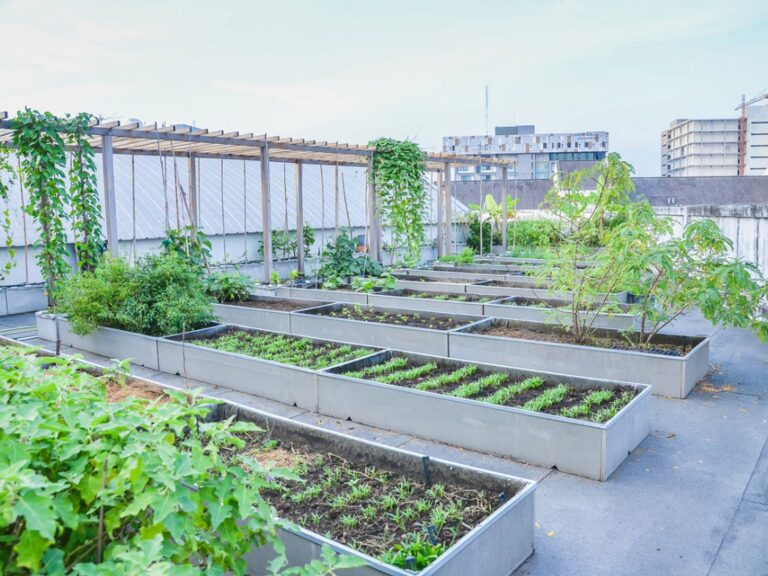
1. Raised Bed Systems (Non-Integrated)
These are independent structures sitting on top of the roof membrane. They offer the best drainage and are the easiest to manage for crop rotation.
-
Trade-off: High point-loading on the roof deck.
2. Integrated “Intensive” Green Roofs
The entire roof surface is converted into a garden bed with multiple layers (protection mat, drainage layer, filter fabric, and substrate).
-
Trade-off: Extremely heavy; requires professional engineering and often permanent modifications to the building’s drainage.
3. Hydroponic and Aeroponic Arrays
Soil-less systems that use nutrient-rich water. These are the lightest options and offer the highest yield per square foot.
-
Trade-off: High technical complexity; failure of a water pump can kill the entire crop in a single afternoon.
Comparison Table: Rooftop Production Models
| Feature | Raised Wood/Metal Beds | Intensive Integrated Soil | Hydroponic (NFT/Tower) |
| Weight (Saturated) | Moderate to High | Very High | Low to Moderate |
| Initial Cost | $15 – $30 / sq ft | $40 – $75 / sq ft | $50 – $100 / sq ft |
| Longevity | 10–15 Years | 30+ Years | 5–10 Years (Equipment) |
| Crop Versatility | High | Maximum | Limited (Leafy/Small) |
| Maintenance | Manual / Traditional | Professional Landscape | Technical / Mechanical |
Detailed Real-World Scenarios Rooftop Vegetable Garden Plans
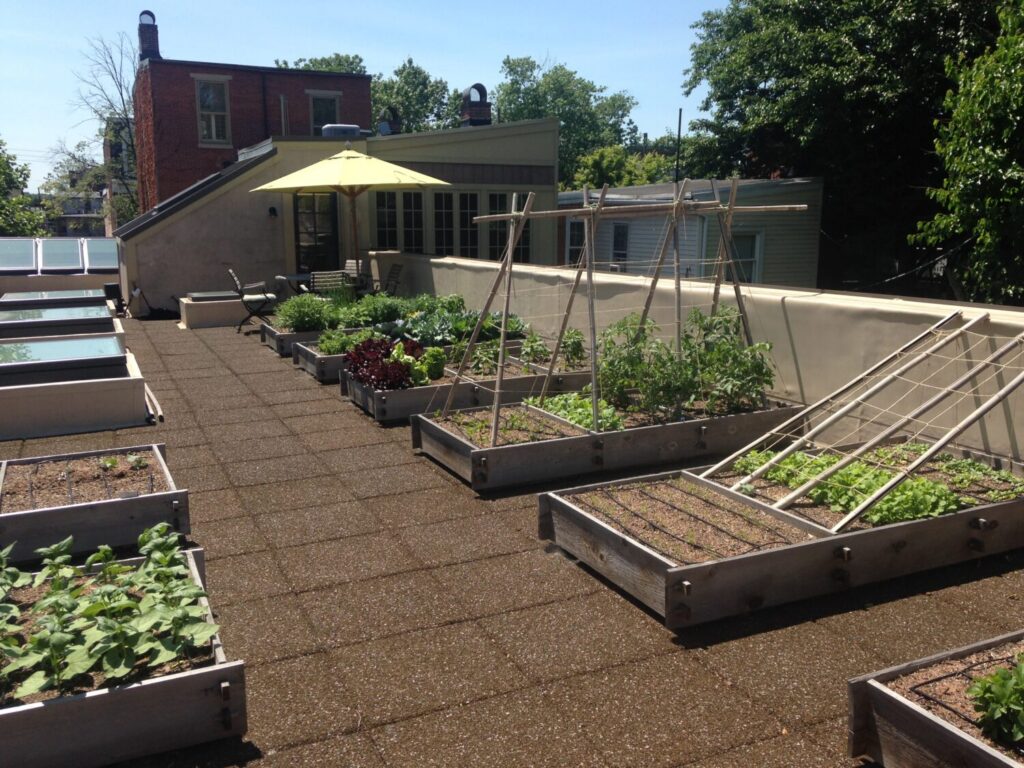
Scenario A: The Post-War Apartment Retrofit
Many 1950s-era brick buildings have limited structural margins. A plan here would utilize “lightweight modular containers” positioned strictly along the perimeter walls.
-
Constraint: No irrigation tap on the roof.
-
Solution: Solar-powered pump drawing from a rainwater harvesting tank located on a lower balcony to minimize weight on the primary roof.
Scenario B: The Modern Commercial Headquarters
A LEED-certified building designed for a “live load” of 100 lbs/sq ft.
-
Plan: Large-scale “intensive” vegetable beds integrated into the building’s HVAC system to use recovered heat for year-round production.
-
Failure Mode: Potential for root-penetration into the waterproofing membrane if the “root barrier” layer is installed with overlapping seams rather than heat-welded joints.
Scenario C: The Windy Coastal High-Rise
In this scenario, vertical growth (trellised tomatoes) is impossible without heavy-duty structural anchoring.
-
Second-Order Effect: The wind not only dries out the plants but can also blow lightweight substrate (perlite) right off the roof. The plan must include “wind-blankets” or heavy gravel mulches to hold the soil in place.
Planning, Cost, and Resource Dynamics
The financial planning for a rooftop garden is frequently underestimated because it fails to account for “vertical logistics.” Moving three tons of soil up an elevator or via a crane is a cost ground-level gardeners never face.
Cost Breakdown: Rooftop Vegetable Projects (USD)
| Component | Cost Range (per sq ft) | Key Variable |
| Structural Engineering Audit | $1,500 – $5,000 (Fixed) | Building Age/Complexity |
| Waterproofing/Root Barrier | $5 – $12 | Material Type (EPDM vs TPO) |
| Lightweight Substrate | $8 – $15 | Bulk vs Bagged Delivery |
| Irrigation (Automatic) | $3 – $7 | Complexity of Zones |
| Safety Railings/Access | $1,500 – $10,000 (Fixed) | OSHA/Code Compliance |
Tools, Strategies, and Support Systems
-
Lightweight Aggregate Substrates: Avoid “potting soil.” Use mixtures of 70% inorganic (expanded clay/shale) and 30% organic (compost) to prevent soil compaction and weight gain.
-
Drip Irrigation with Moisture Sensors: Evaporation rates are 30–50% higher on a roof. Overhead watering is wasteful and increases humidity-related fungal issues.
-
Anemometers: To track wind speeds and trigger automated retractable covers or windbreaks.
-
Electronic Leak Detection (ELD): A system installed under the garden that alerts the manager to moisture reaching the roof deck before it enters the building.
-
Modular Root Barriers: Heavy-duty polyethylene sheets that prevent aggressive vegetable roots (like mint or squash) from seeking out cracks in the roof.
-
Pest Management (Vertical): Rooftops have fewer ground pests (slugs/rabbits) but higher avian and wind-borne pest pressure (aphids). Strategies must focus on physical netting.
Risk Landscape and Failure Modes
The “Compounding Risk” in rooftop gardening is that a biological failure (dead plants) is often a symptom of a mechanical failure (clogged drains).
1. The Hydraulic Bath
If the drainage layer of the garden becomes clogged with soil fines, the roof becomes a pond. Water weighs 62.4 lbs per cubic foot. A few inches of standing water can quickly exceed the “Safety Factor” of the building’s structural design, leading to ceiling cracks or catastrophic deflection.
2. Membrane Abrasion
Workers walking on the roof to tend vegetables can grind grit into the waterproofing membrane. A single puncture can cost thousands of dollars in “overburden removal” to find and fix.
3. Thermal Bridging
A wet garden bed in winter can act as a “cold sink,” drawing heat out of the building and increasing heating costs, potentially negating the “green” benefits of the project.
Governance, Maintenance, and Long-Term Adaptation
A rooftop vegetable garden is a living asset that requires a “Maintenance Protocol” as rigorous as an HVAC service schedule.
-
Quarterly Drain Audits: Ensuring no substrate or plant matter is obstructing the roof’s primary and secondary (overflow) drains.
-
Annual Nutrient Testing: Rooftop substrates leach nutrients quickly due to high drainage. Regular testing is required to prevent “salt buildup” from synthetic fertilizers.
-
Salt Management: In coastal cities, salt spray can accumulate on leaves and in the soil. A “leaching” schedule must be planned to flush the substrate periodically.
Measurement, Tracking, and Evaluation
-
Quantitative Signal: Yield per square foot per gallon of water used. This measures the efficiency of the resource loop.
-
Qualitative Signal: Biodiversity counts. Are pollinators reaching the roof? A “dead” garden with no insects is a sign of ecological stress or over-chemicalization.
-
Documentation Example: A “Load Tracking Log” where every bag of new compost or mulch added to the roof is weighed and recorded to ensure the cumulative weight remains within the engineered limit.
Common Misconceptions
-
“It’s just like gardening on the ground.” No. It is gardening in a desiccator. The air is thinner, the wind is harsher, and the light is more intense.
-
“Any roof can host a garden.” Many older flat roofs were designed only for the weight of snow. Adding a garden requires a structural engineer’s stamp of approval—no exceptions.
-
“Vegetables help the roof last longer.” While they shade the membrane, the increased moisture and human traffic often decrease the lifespan of the roof unless specific “protection layers” are used.
-
“It’s a great way to save money on groceries.” Given the vertical logistics and structural costs, rooftop vegetables are often the most expensive produce on earth. The value is in the “ecosystem services,” not the grocery bill.
Conclusion
Success in urban agriculture depends on the transition from a “plan for a garden” to a “plan for a system.” Effective rooftop vegetable garden plans are those that acknowledge the inherent hostility of the rooftop environment and design around it. By prioritizing structural integrity, hydraulic management, and microclimate adaptation, an urban roof can become a high-output asset. However, this requires a level of patience and editorial precision that views the building as a partner in the biological process, rather than just a stage for it. The future of the city is green, but only if that green is built on a foundation of sound engineering.